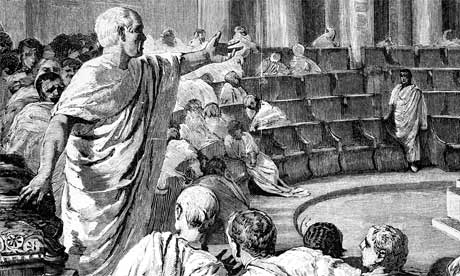
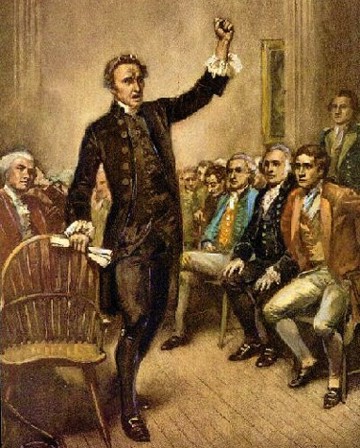
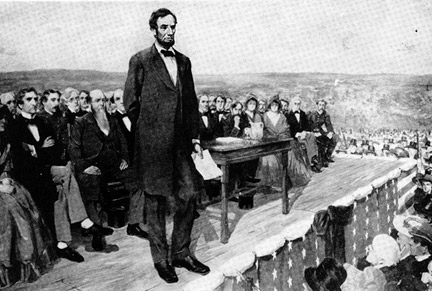
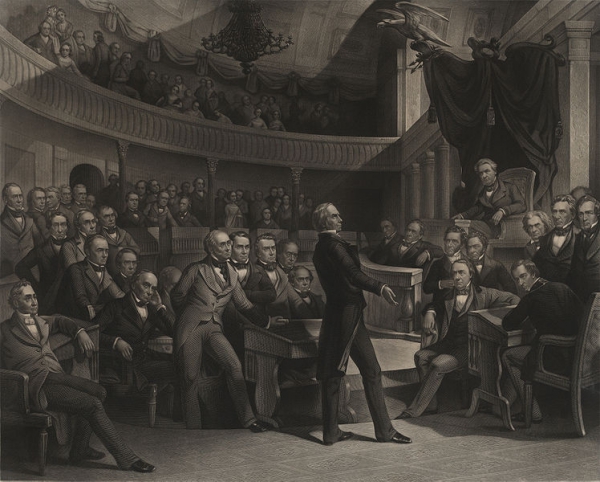
master the pause, watch your body language, vary your tone, let gestures flow naturally, match your speed with your emotion, vary the force of your voice, enunciate, look your audience in your eye
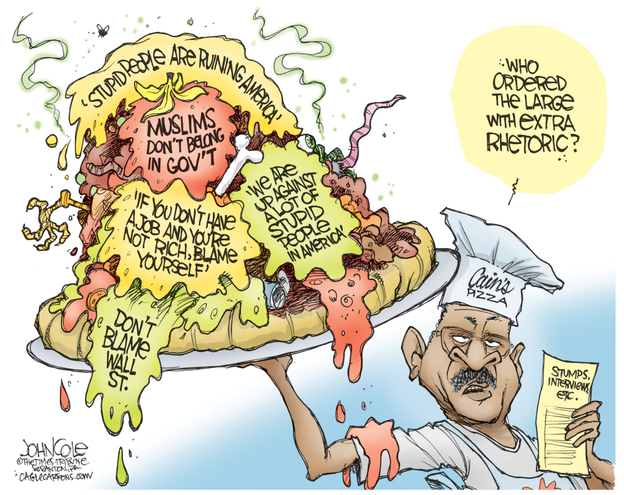
It’s true (and perhaps to be expected) that rhetoric is implicitly defined here as bombastic sound-bites, caustic charges thick with generalization, delivered with unexamined confidence. Sadly, we’ve gotten used to having rhetoric framed this way (though we certainly should not accept it). What interests me, though, is the use of “extra” that’s further emphasized with the heaping mess of pizza glob and goop. It points us to a quantitative framing of rhetoric instead of a qualitative one. To stick with the metaphor: rhetoric may be perfectly acceptable as a garnish, a topping to be sprinkled judiciously on something substantive, but if the “toppings” are piled too high and wide we’ll get sick.
It’s a remarkably unproductive way to frame rhetoric that should signal to rhetoricians everywhere that our work is cut out for us . . .
"Methodological Dwellings: A Search for Feminisms in Rhetoric & Composition"
On a more personal note (or at least professionally-selfish), I’d like to offer thanks to Gae Lyn Henderson, Assistant Professor at Utah Valley University, for her review of the recently published Activism and Rhetoric, a simply stellar collection of essays curated by Seth Kahn and JongHwa Lee. I’ve been fortunate enough to pursue this volume over the past few weeks and am energized by what Kahn, Lee, and the various contributors have accomplished.
For those also interested in affective/non-rational elements of rhetoric, check out Nathaniel Rivers’s, “In Defense of Gut Feelings: Rhetorics of Decision-Making,” which is an insightful and deftly managed piece on a notoriously difficult topic. (And if any of you Harlot readers out there will be joining me at this summer’s “Non-rational Rhetorics” workshop led by Diane Davis and Debra Hawhee, be sure to head over to the latest issue of Philosophy and Rhetoric, which has fresh essays by both.)
Thanks to all in the rhetoric community who keep exploring new realms of rhetoric with their research —
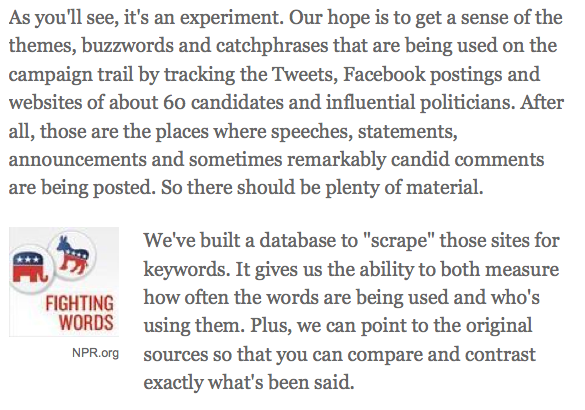
NPR has officially won my “Rhetorician of the Week” award, for their new project: “Fighting Words.” Here’s how they describe it:
Check out this video for a sixty-second overview of the project:
NPR is doing great work here in helping cultivate civic rhetorical literacy, simply by providing the data needed for analysis. The one critique that I believe is worth mentioning, however, is the title of the project: Fighting Words. It seems they’ve fallen into that well-worn groove of envisioning argument and debate only in terms of WAR.
Lakoff and Johnson’s Metaphors We Live By reveals just how deeply this association has ingrained itself into our everyday expressions and thought patterns; here are just a few examples they list:
Your claims are indefensible.
He attacked every weak point in my argument.
His criticisms were right on target.
I demolished his argument.
I’ve never won an argument with him.
He shot down all of my arguments.
The language we use to frame the practice and process of debate significantly impacts how think about and respond to it. NPR is taking the same route that the lame-stream media takes in trying to boost their ratings: amplify the sense of contentiousness to get viewers to tune in.
Every time I hear these metaphoric frames of aggression and war invoked without a thought given to their long-term consequences, I think of all the different ways we might envision argument. As Lakoff and Johnson so eloquently put it:
Imagine a culture where an argument is viewed as a dance, the participants are seen as performers, and the goal is to perform in a balanced and aesthetically pleasing way. In such a culture, people would view arguments differently, experience them differently, carry them out differently, and talk about them differently.
So, I like ProfHacker. For realsies, it’s one of the few blogs where I read 75% of the posts (it used to be a lot more before they changed their rss feed to only preview the articles). Part of what I like about that blog is that they deal with what I’m going to call, right here, right now, without knowing if there is actually a term out there: counter-persuasion.
It’s like this: our things (supposedly, at least) are made to engage us, but when these things are too engaging we can suffer from the consequences of being distracted from the things we’re supposed to be accomplishing. When I avoid writing because I’m on facebook, it’s because, well, facebook is just so engaging. Or email. Or tv. Or whatever. So, ProfHacker posts such articles as “6 Ways to Avoid Letting Your Computer Distract You.” This article is specifically reporting on programs which aim to reduce or eliminate the technological things that lure you into using them: email, internet, social networking sites, etc. The distracting devices/services/sites cannot persuade you into interacting with them because of these programs which eliminate the distraction altogether. You know where I’m going with this. That’s right, say it with me now: counter-persuasion.
These programs are made specifically to counter act the persuasive temptations that exist with current technology. If you could see the image in my head when I think about this, it looks something like this:
Original photo via Bruce Turner, flickr
But, I digress.
More or less, I like the cyclical idea here that the software itself is persuasive because it’s reducing the temptations and persuasiveness of other softwares; that the use of counter-persuasion is persuasive itself. It’s a bit convoluted, I grant you, but cool nonetheless.
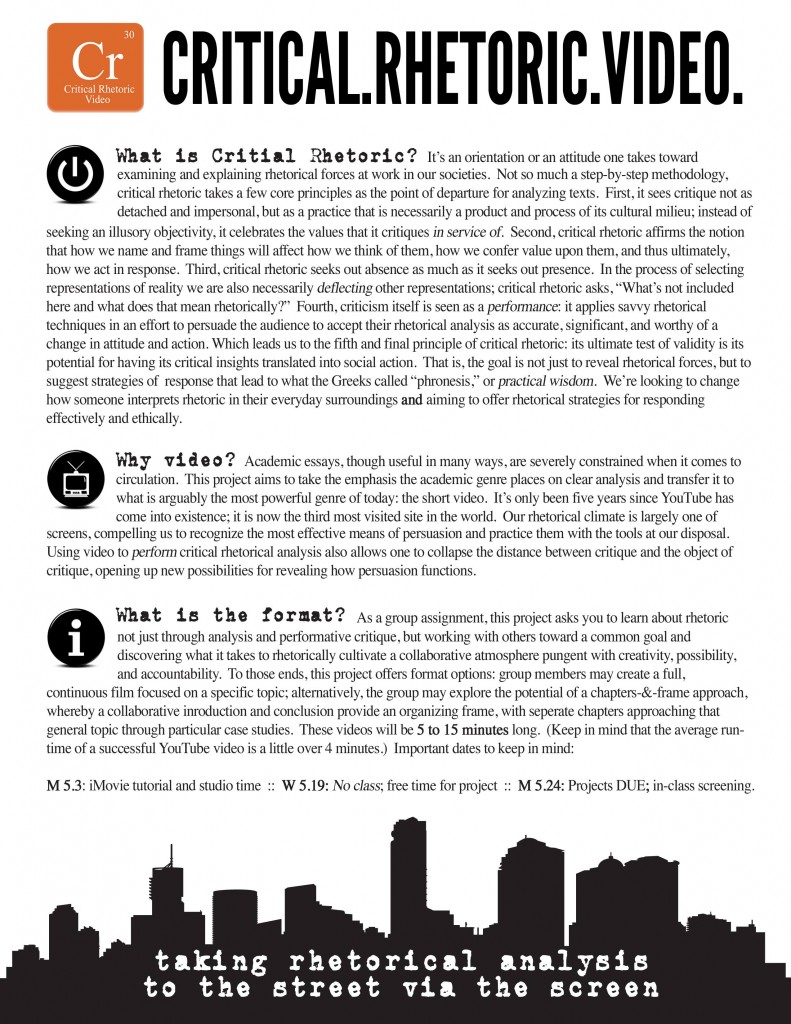
Right now there are a gaggle of imaginative and intelligent students at Ohio State working on Critical Rhetoric Videos, an assignment that takes Raymie McKerrow’s concept of “Critical Rhetoric,” but uses digital video instead of print to perform the critique.
(go to www.elementsof276.blogspot.com to learn more about this assignment)
In attempting to better identify which rhetorical appeals will work best for their target demographic (mostly those between the ages of 19 and 26), we consistently come back to humor. This has me contemplating the potential value of a “precursor project”–more specifically, a parodic precursor–that would focus on the strategic use of humor before moving on to a project like the Critical Rhetoric Video.
So I thought I would share with you some great examples of parody, a term the Greeks used to describe works that imitated the epics in humorous fashion, poking fun at the style of master narratives. (Just consider the etymology: para (along side of) + ode (as in “lyrical ballad”).)
These examples are astounding for their efficiency in revealing the rhetorical structures of the genre they’re poking fun at, while engaging the audience with their own set of smooth rhetorical maneuvers:
(thanks to Alex Speck, who tipped me off to this bit-o-genius)
Rhetoric-centric journals are popping up all over the web these days. Take note of the newcomers:
The Journal of Undergraduate Multimedia Projects (JUMP) “is an electronic journal dedicated to 1) providing an outlet for the excellent and exceedingly rhetorical digital/multimedia projects occurring in undergraduate courses around the globe, and 2) providing a pedagogical resource for teachers working with (or wanting to work with) ‘new media.’ The journal is designed to be not only a repository for quality multimedia scholarship—bringing together some of the most rhetorically creative and rhetorically impactful works produced/composed by our undergraduates—but also, unlike its digital brethren (i.e., mega repositories like YouTube), it seeks to also offer a critical perspective” (from “about The Jump“).
Present Tense: A Journal of Rhetoric in Society “is a peer-reviewed, blind-refereed, online journal dedicated to exploring contemporary social, cultural, political and economic issues through a rhetorical lens. In addition to examining these subjects as found in written, oral and visual texts, we wish to provide a forum for calls to action in academia, education and national policy. Seeking to address current or presently unfolding issues, we publish short articles of no more than 2,000 words, the length of a conference paper” (from “about Present Tense“).
Relevant Rhetoric: ANew Journal of Rhetorical Studies “is a refereed online journal created to publish pieces of academic rhetorical criticism that are of value not only to academic scholars and historians interested in persuasion, but also to the educated lay-public. The journal seeks to further our understanding of and conversation about modern persuasive practices with the largest possible audience” (from their “about” page). “The emphasis of Relevant Rhetoric: A New Journal of Rhetorical Studies is on the context of discovery rather than the context of justification. This means that the writing and editorial conventions practiced by most academic journals is modified so that the focus of each article is on the author’s findings, conclusions, interpretations, or suggestions, rather than previous literature and research methods” (from their submissions page).
Since I brought up one academic’s view on the state of the educational system last week, it’s certainly worth sharing the view of an outspoken non-academic–Dan Brown and his “Open Letter to Educators“:
What I find particularly exciting, is that Dan’s confrontation and engagement with the problems in institutional education has caused him to change his own actions. He plans to continue engaging in other important conversations after seeing the kinds of interaction and dialogue that can come from contemplating these important topics:
I think that is stellar cool.
Now, of course, some people would disagree with Dan’s thoughts/opinion. This guy, for instance:
Personally, I think they both do raise thought-provoking points, but I have to side with Dan on this one. Maybe it’s the other guy’s snarkiness and continual attack against Dan as a college dropout (which, I think, does not give him much credibility in understanding the amount of people who aren’t college educated), but, to me, arguing that “this is the way things have always been done, so we’re gonna keep doing it” is not a valid counter-argument. I fail to see what is wrong with creating an environment where students are engaged. Yes, each student is responsible for their own education and they should actively involve themselves in class discussions, exercises, etc. for their own benefit. I truly do believe that, but, as anyone who has spent time in a classroom environment knows, environments where students are engaged leads to better discussions. It’s leads to a better learning environment. And, for educators, shouldn’t that be the point?
I’m not trying to discount research. Of course, research is important and beneficial to our society, but it’s only one facet of the educational system. That’s why some fields delineate between researchers and those who practice that research. But, if we’re talking about “educators,” then they should be invested in and concerned with educat-ing. To me, that means also being open to better ways of doing just that.
David Wiley of Brigham Young University gave a talk at TEDxNYED which discussed “Open Education and the Future.” The slides themselves are below, but I think it would benefit you more by reading Wiley’s post of this presentation at his site.
What, of course, peaks this little harlot’s interest is Wiley’s concluding comments where he says:
Education has to some degree lost its way; forgotten its identity. We’ve allowed ourselves and our institutions to be led away from our core value of openness – away from generosity, sharing, and giving, and toward selfishness, concealment, and withholding. To the degree that we have deserted openness, learning has suffered.
You see where I’m headed with this, right? While Wiley’s comments are more strictly geared toward the eduction system and the students within it, I think this can easily be expanded to include everyone. And if it does include everyone, then Harlot is a response to that. Maybe other people are also catching on to our own concerns. Maybe we all want to be a little more accessible and open. People are changing and maybe Harlot’s one example of how we’re changing with it?