
Our choice of words helps facilitate certain thoughts and empowers particular logics, while disciplining others. This is a foundational principle of rhetorical studies and probably nothing new to many of this blog’s readers.
Every once and awhile, though, I realize just how high the stakes really are.
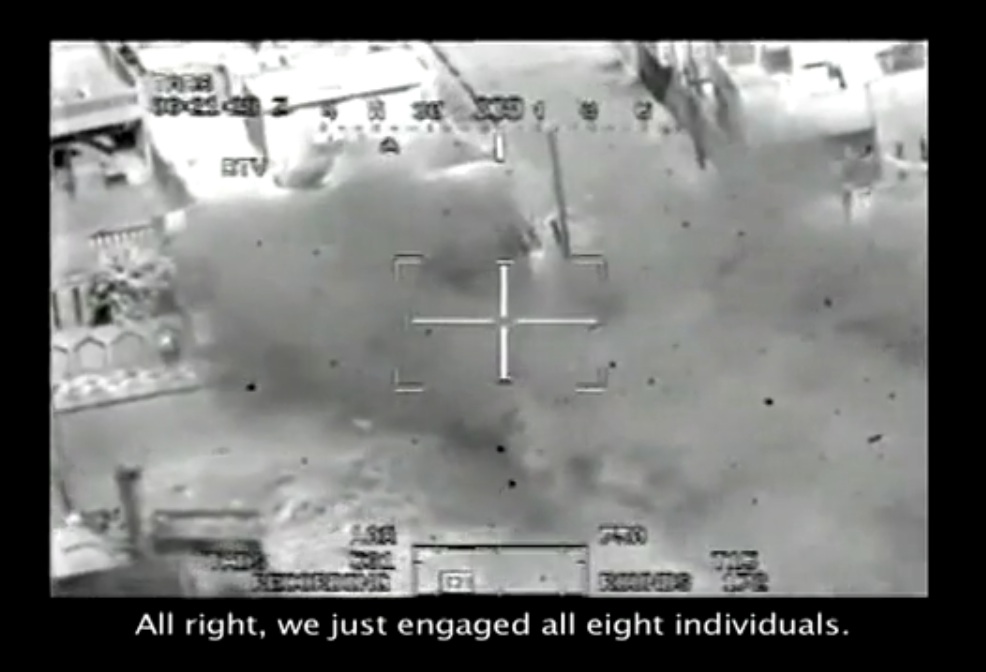
The video below was found at WikiLeaks, “a website that publishes anonymous submissions and leaks of sensitive governmental, corporate, organizational, or religious documents, while attempting to preserve the anonymity and untraceability of its contributors. Within one year of its December 2006 launch, its database had grown to more than 1.2 million documents” (wikipedia entry). It is a classified US military video that shows the shooting of a dozen people in a suburb of Baghdad. Among the victims were two Reuters news staff. Two children are also involved.
Please take caution: this is raw footage, complete with the Army’s audio, of people being shot.
I deliberated on alternatives for “being shot” for quite some time. Perhaps–“this is raw footage of people being murdered.” Or “slayed.” Or “wrongly identified and accidentally fired upon.”
Slaughtered? Invalidated? Massacred? Killed? Rendered collateral damage?
Or, perhaps: engaged.
In the video you hear the military personnel saying, “We just engaged all eight individuals.”
It’s important to note that the video’s opening frame is a quote by Orwell’s 1946 essay, “Politics and the English Language”:
[Political language is] designed to make lies sound truthful and murder respectable, and to give an appearance of solidity to pure wind.
Elsewhere in that essay Orwell writes, “political speech and writing are largely the defense of the indefensible.” I think the assumed interpretation of this is meant to indicate the government’s defense to the public. This language is then, of course, picked up by the body politic, replicated by supporters to other members of the public. This language becomes the banal standard, the terms we use–whether we’re for, against, or indifferent–to communicate.
But I wonder if we might think about how we use smokescreen language like this on ourselves, to psychologically shield ourselves from what we know is “indefensible,” which could be translated here as “unconscionable.”
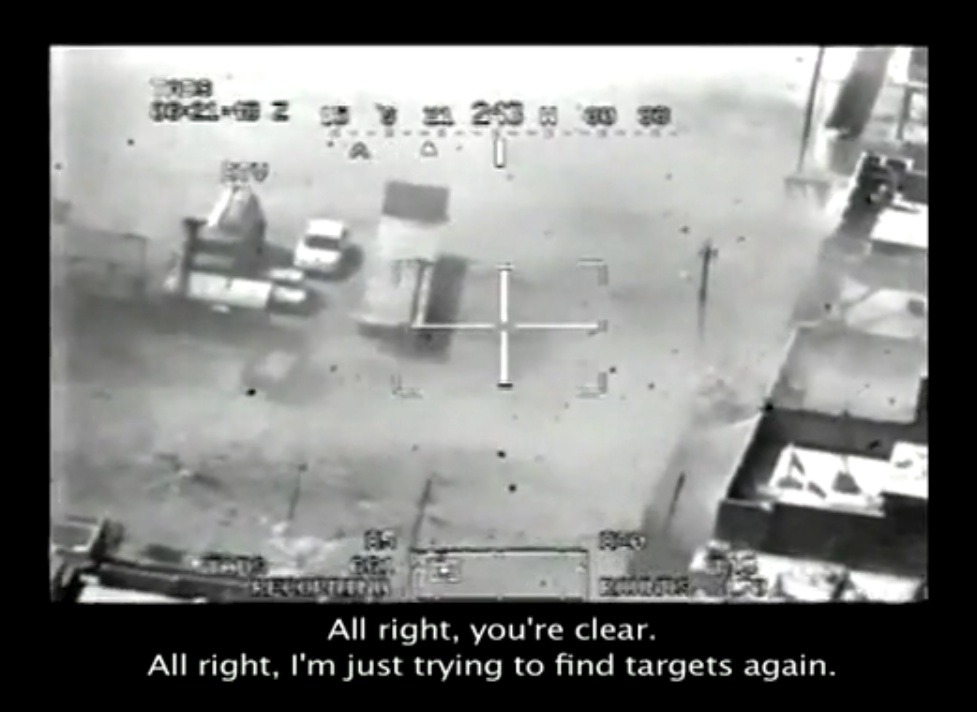
So when the soldier in this video says, “I’m just trying to find targets again,” we could say it’s because it’s what allows him “to do his job” (another phrase of justification, used to pass accountability to another realm). Can you imagine it rephrased?
“I’m just trying to find a breathing body that has hopes and dreams like you and I to send a piece of metal through so that his blood will mix with the sand.”
This isn’t a piece about placing praise or blame on soldiers. This isn’t the forum for such a critique; and having known several veterans of Iraq, I would never hastily condemn the individual without knowing more. (For instance, what if the person doing the shooting ultimately found such an act reprehensible and leaked the video himself in a courageous attempt to right a wrong?)
This is a forum about language and its consequences.
Military speak is an extreme example of language that shields its users from discussing the indefensible. It’s easy for us to assume that we are separate from those who must use linguistic mirrors to either do what they’re told or justify daily action. But if you find this use of language chilling in its brutal efficacy, perhaps you’re willing to try something…
Let’s search for all those terms that displace our own accountability. Let’s identify them, interrogate them, and reframe them for the better. And let’s do it in a public forum.
Habitat loss and endangered species perform the same function that collateral damage and enhanced interrogation techniques do. They are terms that permit–indeed facilitate–thinking that directs us away from a frame of accountability.
For those that think it’s a stretch to align environmental atrocity with the atrocity in the video below, you might first question how the two aggressions, rationale and even people behind those acts are similar. The connections are staggering.
And so I’m calling on all rhetoricians, language-lovers, and wordsmiths to raise the stakes a bit, and using the emotion generated by the video below, to take ownership of language in such a way that it becomes infused with accountability and agency.
There’s a fascinating article in the NY Times today about this video: http://www.nytimes.com/2010/04/08/world/08psych.html
The article clearly sets out to make the audience at least slightly more comfortable with the callousness displayed by the soldiers. Quoting psychologists, the article explains why and how soldiers are trained to depersonalize the enemy:
“You don’t want combat soldiers to be foolish or to jump the gun, but their job is to destroy the enemy, and one way they’re able to do that is to see it as a game, so that the people don’t seem real,” said Bret A. Moore, a former Army psychologist
“But at a more primal level, fighters in a war zone must think of themselves as predators first — not bait.”
It strikes me that the real tragedy here is this very conceptualization of military action — as predatory destruction. This is not how most of my friends in the military would describe their mission or motives, which have as much to do with peace-keeping and security and negotiation as with the kind of aggressive othering evident in this language. Call me naive, but I’d like to give the US military more credit for complexity than these experts do. At least, their mission statements are more careful, if carefully ambiguous, in their language choices. It’s a shame to watch the “experts” justify these actions by reducing soldiers to death-dealing predators.
The comments section on the NY Times article is well worth checking out…
…and language use is but one of several technologies designed to alienate, to dehumanize, to disembody, to distance the soldier from the adversary: remote-controlled drones, “smart” bombs, videogame-style training simulations, among others.